The Builders: Joe Navarro, Eric Drache, Jack McClelland, Mori Eskandani and Henry Orenstein
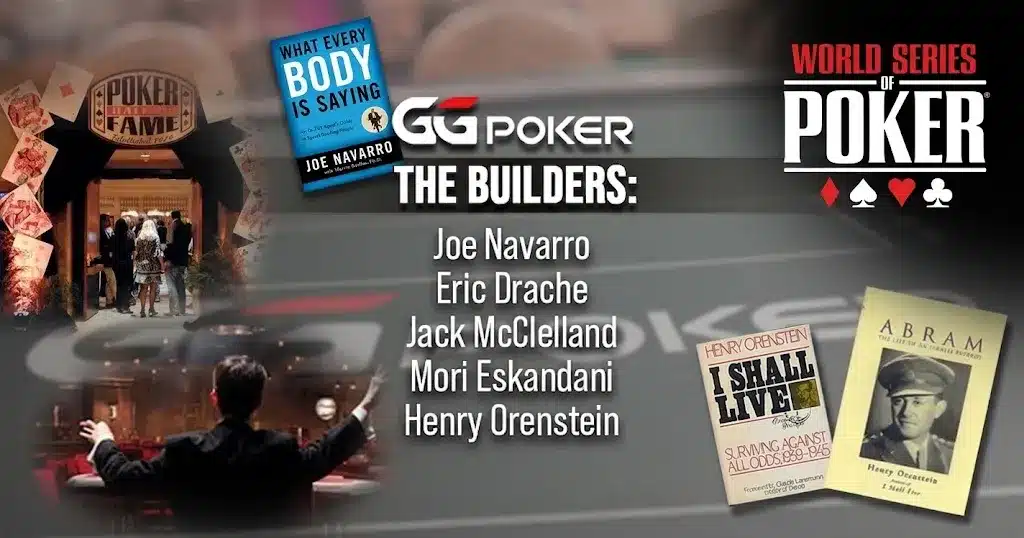
The history of poker usually gets told through the people who won. The bracelets, the Main Event champions, the names that turn up when you search a results database. But the game you actually play and watch today — the one you can qualify into for a few dollars and follow card by card on a screen — wasn’t built at the table. It was built by a handful of people who mostly stayed off camera.
That is the thread running through these five. A former FBI agent who made a career out of reading what people try to hide. The director who invented the cheap way into the big game. The one who made the tournament itself run clean. The producer who decided what poker looked like on television. And the inventor who, more than anyone, made the hidden hand visible. For most of poker’s life the most important people in the room were the ones you couldn’t see. Here are five of them.
Joe Navarro: The Read

Joe Navarro spent 25 years as an FBI counterintelligence agent, which is a formal way of saying he got paid to read people. Born in Cienfuegos, Cuba, in 1953, he came to the United States as a boy when his family left the island, and he joined the Bureau at 23. For a quarter century his job was to notice the things people didn’t mean to show — the shift in posture, the hand that drifts to the throat, the foot that turns toward the door — in rooms where the stakes were a good deal higher than a pot.
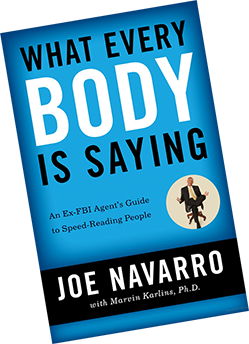
When he retired, he pointed that skill at poker, and it fit almost perfectly. Poker is a game of incomplete information, and every extra read is worth money. Navarro’s book “What Every BODY is Saying” sold over a million copies, not because it was written for card players but because reading people is useful everywhere. His poker-specific follow-up, “Read ‘Em and Reap,” did for the table what the first book did for everyday life.
His real contribution wasn’t a list of tells. It was a way of thinking about them. He sorted the physical signals into categories — pacifying behaviors that surface under stress, displacement gestures that leak discomfort, the small involuntary slips that betray real intent — and taught players to weigh a read by how reliable it actually was, rather than treating every twitch as gospel. That is the difference between studying tells and just staring at people.
I’ve watched players bore a hole through an opponent hoping a tell will fall out, which is not the same thing as reading one. Navarro’s framing is more useful: know the baseline, watch for the break from it, and don’t stake the pot on a single flinch. The idea holds up online too, where the body is gone but the behavior isn’t — it just moves into timing, bet sizing, and how a player reacts to pressure.
That reframe is the lasting part. Navarro pulled the conversation away from pure probability toward the fuller picture, the part of the game that lives in what people reveal without meaning to. It is a fitting place to start, because the story of how modern poker got built is largely the story of the parts you were never supposed to see.
Eric Drache: The Way In

Eric Drache ran the World Series of Poker from 1973 to 1988, and if you have ever won your way into a big tournament for a fraction of the buy-in, you are using his idea. Drache invented the satellite: a smaller, cheaper tournament whose prize isn’t cash but a seat in the main event. It sounds obvious now. It wasn’t. Before the satellite, the big buy-in events were closed to anyone who couldn’t put up the full stake, which kept the fields small and the game clubby.
The impact is easiest to see in the numbers. During Drache’s run as director, the Main Event grew from a single table’s worth of players to more than 160, and the mechanism that fed that growth was the satellite. The same idea, scaled onto the internet two decades later, is what put thousands of qualifiers into events they could never have afforded outright, and produced more than one unknown world champion along the way.
Drache’s fingerprints are on the less visible machinery too. He developed ante structures, built dealer training programs, and popularized the must-move or feeder table that keeps a big field moving without breaking the game — standard equipment in every tournament room now. He ran the floors at the Golden Nugget and the Mirage, where he trained a generation of people who went on to run rooms of their own.
His own story had a hard turn. In the mid-1990s a federal tax case cost him his Nevada gaming license, which meant he could never work a casino floor again. Most careers end there. Drache’s didn’t — he moved into television, consulting for NBC, and stayed in the game from the production side. The Poker Hall of Fame inducted him in 2012. That pivot from the floor to the broadcast booth is worth holding onto, because the next two men built their whole legacies there.
Jack McClelland: The Machinery

If Drache built the way into the tournament, Jack McClelland made the tournament itself run like a craft. He took over as WSOP Tournament Director in the 1980s, and the title undersells the work. A tournament director sets the blind structure, the pacing, the payout jumps — the decisions that quietly dictate how every player at every table has to approach the game. Get them wrong and a well-run event comes apart at the seams. McClelland treated it as a discipline, not a clipboard exercise.
The thing about good tournament direction is that you only notice it when it’s missing. I’ve sat through enough badly run events to appreciate the ones where someone clearly thought the whole structure through in advance — where the levels felt fair to grind and the day didn’t collapse into chaos at the bubble. By every account, McClelland’s were the latter. The good ones feel effortless precisely because someone did the unglamorous work up front.

He wasn’t only an administrator. As a player his live tournament winnings passed $375,000, with four final tables and 17 money finishes at the WSOP, including a 5th-place run in the $10,000 Seven Card Stud Championship in 2021 — proof that the man setting the rules could hold his own playing inside them. That perspective fed the work. He knew which structures rewarded skill and which ones punished good play for no reason, and he built accordingly, which is exactly the kind of judgment the best tournament formats are made of.
In 2002 he took over the poker room at the Bellagio and brought the same standards with him, turning it into a fixture on the serious circuit — a room where regulars could trust the daily tournaments to start on time and pay out the way the sheet said they would. That kind of consistency keeps players coming back more than any single marquee event does. The Hall of Fame inducted him in 2014.
Mori Eskandani: The Lens

Mori Eskandani was a player before he was a producer, and a good one. Born in 1956, he learned the game in the card rooms of Portland before moving to Las Vegas in the mid-1980s, and in 1993 he finished 15th in the WSOP Main Event — a serious result in a field already thick with the pros he would spend the rest of his career working alongside. But his lasting mark isn’t a finish. It’s the way an entire generation experienced the game.
As the 2000s arrived, Eskandani moved from the table to the booth with a clear idea of what poker on television could be: entertaining and instructive at once, not just a scoreboard. His first show, in 2004, was Poker Superstars, and he co-created it with Henry Orenstein — a name worth holding onto, because it comes back at the end of this story.
From there his production company, PokerPROductions, became the machine behind modern poker television: “Poker After Dark,” “High Stakes Poker,” the National Heads-Up Championship, the WSOP on ESPN. If you fell for the game watching a cash table full of stars needle each other over six-figure pots, that was his camera and his edit at work. Those broadcasts are where a lot of players first met the names from the big game. He is now president of PokerGO, which means he is still deciding what poker looks like on a screen.
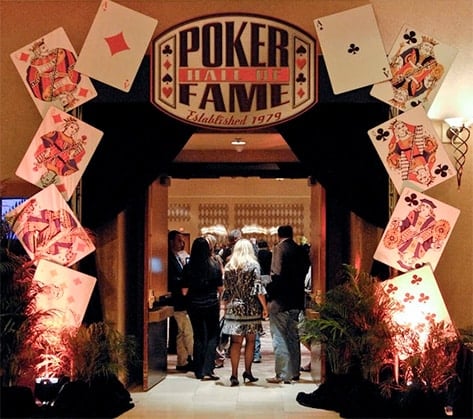
Eskandani was inducted into the Poker Hall of Fame in 2018, and the honor covered both halves of his career at once — the player who went deep in the Main Event and the producer who changed how the rest of us watch. But every one of those broadcasts depended on a single piece of technology, one that didn’t exist for most of poker’s history. The man who invented it is the last builder in this group.
Henry Orenstein: The Camera

Henry Orenstein’s life is almost too large to fit in a poker profile, so start with the fact that anchors everything else: he survived. Born in Hrubieszow, Poland, in 1923, he lived through five Nazi concentration camps before the war ended, an experience he later set down in a memoir, “I Shall Live.” The man who would eventually make poker’s hidden cards visible spent his youth surviving the unseeable.
He rebuilt from nothing in the United States. After a stretch at a canning company he moved into toys, founded Topper Toys, and built hits out of the “Suzy Cute” dolls and the “Johnny Lightning” cars. He ended up holding more than 100 patents. His biggest toy legacy is one most people never connect to him: he was the catalyst who convinced Hasbro to buy the Japanese Diaclone and Micro Change lines and repackage them as Transformers.

Then, in his seventies, he changed poker for good. Televised poker had a fatal flaw — you couldn’t see the players’ hole cards, which meant you couldn’t follow the drama of a bluff or a big laydown. Orenstein’s fix was a camera set under a small glass window in the table, letting the audience see each player’s cards without disturbing the game. His patent was approved in 1995. Late Night Poker used it in Britain in 1999, ESPN put it on the WSOP in 2002, and the boom followed. One NBC executive later said Orenstein was single-handedly responsible for the success of poker today.
He could play, too. In 1996 he won a WSOP bracelet in the $5,000 Seven-Card Stud event, and the Poker Hall of Fame inducted him in 2008. He died in 2021, at 98.
And here the thread pulls tight. For most of its history poker’s most important action was the part you couldn’t see — the hole cards, the buried tell, the decisions made off in a corner of the room. Orenstein’s camera flipped that. It made the hidden hand visible and turned a private game into something a stranger could watch and fall for. The irony is that the men who built all of it stayed exactly where they had always been: out of frame.
Built Off the Felt
Line these five up and the shape of modern poker appears. The satellite that got you into the tournament. The structure that kept it fair once you sat down. The read that gave you an edge over the player across the table. The broadcast that made you want to play in the first place. And the camera that let you see any of it at all. Not one of them needed to win a hand to change the game more than most champions ever will. That is the part the highlight reel leaves out: the game gets built off the felt, by the people the camera never bothered to find.
👉 Use Referral Code: WINBIG 👈TAKE YOUR SEAT
About the Author: Maury Orton is a poker writer and editor contributing to GGPoker. He focuses on clear, reliable explanations of the game, drawing on years of experience in online poker media and digital publishing.